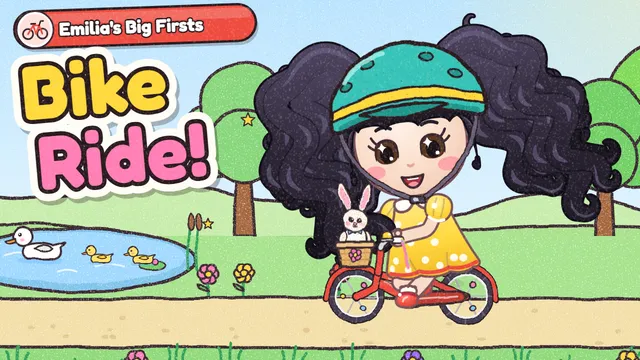
Emilia's Big Firsts · Story 7
About “Emilia's First Bike Ride”
- Ages: 3-5
- Length: 5 min
- Season: Emilia's Big Firsts, story 7
A shiny red bike with a bell and a basket for Pip! Emilia learns to pedal and balance, takes a little tumble, gets back on, and rides all by herself while Daddy cheers.
Learning to ride includes falling, and this story doesn't skip that part. Emilia clicks her helmet buckle before anything else, finds the pedals while Daddy holds the seat, and works on staying balanced. Then the bike tips, she lands on the grass with a scraped knee, and her eyes fill with tears. Daddy hugs her, a bandage with stars goes on, and only then does she choose to try again. On the second go he lets go without her noticing, and she rides past the ducks and swings by herself. For a child who quits after one tumble, it shows that trying again is part of learning.
- learning to ride a bike
- helmet safety
- trying again after a fall
- balance
This story is coming to YouTube soon. You can read it below and print its coloring page now.
The three big words
- helmet
- A hard hat that keeps your head safe.
- pedal
- The part you push with your feet.
- balance
- Staying up, steady and straight.
Tips for grown-ups
- Make the helmet the very first step, every time, the way it is for Emilia. The AAP says children need a helmet on every ride, no matter how short, and that most bike crashes happen near home.
- Check the fit together. The AAP describes a helmet that sits level, covers the top of the forehead, doesn't slide when pushed, and has a snug chin strap, with a label inside showing it meets the CPSC standard.
- Pick a bike that fits now rather than one to grow into: the AAP says your child should be able to sit on the seat, hands on the handlebars, with the balls of both feet on the ground.
- Practice somewhere protected, like the park in the story. The AAP's advice for young riders on tricycles is to stay away from cars and driveways.
- If there's a tumble, follow the story's order: comfort first, then a bandage, then a calm question about trying again.
- Let your child set the pace. The AAP advises not pushing a two-wheeler before a child is ready, at about age 5 or 6, and says most children are ready for a tricycle around age 3.
Talk about it
After watching, ask:
- What did Emilia put on before riding?
- Where did Pip ride?
- What happened when the bike wobbled?
- What was on Emilia's bandage?
- What did she do after she fell?
- What sound does her bell make?
Try this together
Practice balance without a bike: walk along a line of tape or a rope on the floor with your arms out, steady and straight, like the story's bird on a wire. Then do a helmet check together in front of a mirror.
Free coloring page
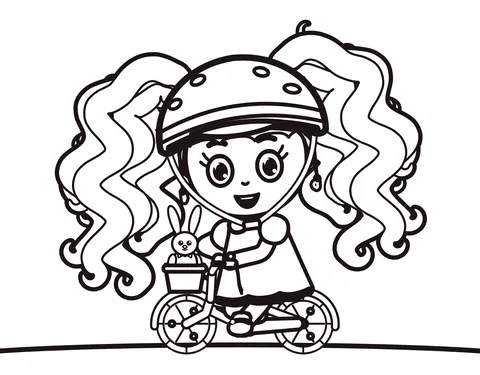
Emilia's First Bike Ride: print it (US Letter or A4) or color it on screen.
Read the story
In the garage, with a bow on the seat,
was a shiny red bike! Oh, what a treat!
It had two round wheels, and a bell that went ding,
and a basket for Pip, the most important thing!
But first, a helmet! It's a hat that is hard,
to keep your head safe, like a strong little guard.
Click went the buckle, right under her chin.
The helmet is on! Let the bike ride begin!
Off to the park, with Daddy and Pip,
for her very first ride, her very first trip!
Her feet found the pedals. Push down, round they go!
Push one, then the other, nice and slow, slow, slow.
And Daddy held on to the seat, strong and steady.
Pedal, pedal! Are you ready? Ready!
The trick for a bike is called balance. Hold tight,
stay up in the middle, not too left, not too right.
Balance is staying up, steady and straight,
like a bird on a wire, or a cat on a gate!
Then the bike went... wobble! It tipped to one side.
Bump! She sat on the grass. She wanted to hide.
Her knee had a scrape, and her eyes filled with tears.
Daddy hugged her and whispered, I'm right here.
A bandage with stars, and a kiss on the knee.
Ready to try again? Okay... one, two, three!
Back on the bike! Pedal, pedal, round and round,
with Daddy behind her, running over the ground.
Then Daddy let go... but she didn't know!
Balance, balance... Look at her go!
She was riding! All by herself! What a breeze!
Past the ducks, and the swings, and the big green trees!
Ding, ding! went her bell, and her curls flew so free.
Daddy cheered! Pip cheered! And so did a bee!
She rang her bell, ding, and she stopped with a squeak.
Her very first bike ride! She smiled for a week!
She rode her bike! She did it! Let's sing,
and clap, and dance, and do the She-Did-It thing!
Then off to her chart, for spot number seven:
a red bike sticker! She was in bike heaven!
Seven big firsts, done! Is she proud? Oh, yes!
Two spots to go! What's next? Can you guess?
Big words today! Say them with me!
Helmet!
A hard hat that keeps your head safe.
Pedal!
The part you push with your feet.
Balance!
Staying up, steady and straight.
Every big first starts out wobbly and new,
then one day you do it! Hooray! Look at you!
Next time, a playdate with Ellie! Bye-bye!
Questions parents ask
What age should a child learn to ride a two-wheeled bike?
The AAP advises not pushing a two-wheeler until a child is ready, at about age 5 or 6. Younger children can enjoy the story and practice the same habits, like the helmet and trying again, on a tricycle.
Does my child need a helmet for a quick ride on the sidewalk?
Yes. The AAP says to wear one on every ride, however short or close to home, because many injuries happen in driveways, on sidewalks and on bike paths.
Do we need a new helmet after a fall?
The AAP says a helmet that has been through a serious fall or crash should be retired, since it may not protect as well the next time.
Sources
Our tips follow these pages. They are general information, not medical advice: ask your child's doctor or dentist about your child.
- Bike Helmets for Kids: Parent FAQs, American Academy of Pediatrics (HealthyChildren.org)
- Bicycle Safety for Children: Myths & Facts, American Academy of Pediatrics (HealthyChildren.org)
- How to Choose the Right Size Bike & Helmet: Tips for Parents, American Academy of Pediatrics (HealthyChildren.org)
- Ready for a Tricycle?, American Academy of Pediatrics (HealthyChildren.org)