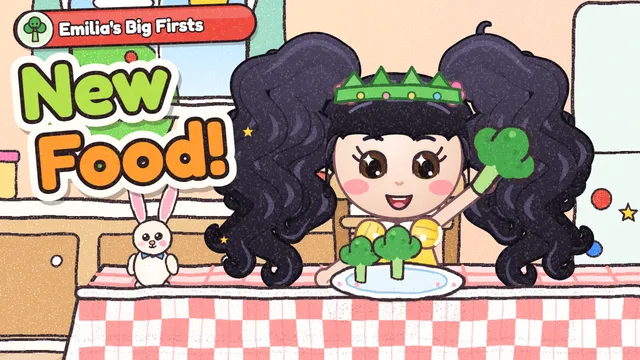
Emilia's Big Firsts · Story 6
About “Emilia Tries a New Food”
- Ages: 2-5
- Season: Emilia's Big Firsts, story 6
Little green trees on her plate! Emilia has never tried broccoli. With Daddy's dinosaur trick and one tiny nibble, she discovers that trying something new is brave, even when you don't like every food.
Nobody in this story tells Emilia to clean her plate. She looks at the broccoli, worries it might be yucky, and pushes it away, and the narrator lets that feeling be. What changes things is play: a short look at how broccoli grows from a seed, then Daddy's idea that dinosaurs love to eat trees. A single tiny nibble later, she finds a crunch she likes. A red tomato and an orange carrot go well too. A mushroom does not, and the story treats that as perfectly fine. The point it makes is that trying counts, whatever the answer turns out to be.
- trying new foods
- picky eating
- being brave
- tastes and textures
This story comes out on YouTube on October 16. You can read it below and print its coloring page now.
The three big words
- nibble
- A tiny little bite.
- crunchy
- It goes crunch when you bite it.
- flavor
- How a food tastes.
Tips for grown-ups
- Ask for one nibble, not a plate's worth, the way Daddy does. The AAP advises against forcing children to eat and suggests letting a child refuse a food but offering it again later.
- Be patient with repeats. The AAP says it can take children 15 to 20 tries to like a new food, so an early no isn't the last word.
- Serve the new food next to something your child already likes, as the CDC suggests.
- Let your child wash, sort or help grow foods. The CDC notes that even the youngest can help, and the AAP says the more involved kids are, the more likely they are to try new foods eventually.
- Talk about texture and flavor instead of good or bad: crunchy or soft, sweet or sour, mild or strong. Emilia's 'not today' for the mushroom shows that saying no is allowed.
- Eat the food yourself where your child can see. The AAP encourages family meals where grown-ups model trying new things.
Talk about it
After watching, ask:
- What did the broccoli look like?
- Who eats trees?
- What sound did the broccoli make?
- What does flavor mean?
- Which food did Emilia not like?
- What new food could you try a nibble of?
Try this together
Hold a tiny taste test with two or three foods and describe each one with the story's words: crunchy or soft, sweet or sour. A dinosaur roar before each nibble is optional but encouraged.
Free coloring page
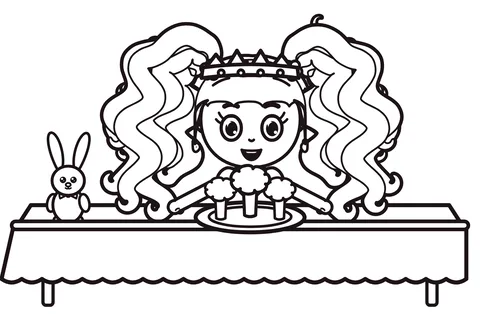
Emilia Tries Broccoli: print it (US Letter or A4) or color it on screen.
Read the story
At dinnertime, Daddy set out a surprise:
little green trees, just the perfect size!
Broccoli! Emilia looked, and looked some more.
She had never tried broccoli, ever before.
She wrinkled her nose, and she squeezed her eyes tight.
What if it was yucky? What if it would bite?
She pushed back her plate, and she shook her head, no.
Trying new things can feel wobbly, you know.
Broccoli grows from a seed in the ground,
with sunshine and rain, till it's leafy and round.
It grew, and it grew, in a garden so green,
the littlest trees that you've ever seen!
Then Daddy said, Trees? Who eats trees? I know!
A great big dinosaur! ROAR! Here we go!
Emilia the dinosaur stomped round the room,
with a ROAR, and a STOMP, and a BOOM, BOOM, BOOM!
Even Pip wanted a turn. Pretend nibble... munch!
Pip wiggled his ear, like: Mmm! What a crunch!
You don't have to eat it all up, Daddy said.
Just try one nibble, with your dinosaur head!
A nibble is a bite that is tiny and small,
like a mouse having lunch. Hardly a bite at all!
So Emilia took one nibble, tiny and slow...
CRUNCH! went the broccoli. Oh! Oh! Oh!
It was crunchy! It made a crunch when she bit,
crunchy like apples. And she... kind of... liked it!
A flavor is how a food tastes on your tongue.
Strawberries? Sweet! Lemons? Sour! Ooh, that stung!
The broccoli's flavor was green, and was mild,
and the little dinosaur smiled, and smiled!
Then a tomato, so red, and so round, and so bright,
and an orange carrot. Crunch! Just right!
But a mushroom? Bleh! Not for her. Not today.
You don't have to love them. Just try. That's okay!
Then the dinosaur pointed. More trees, please! More!
So Daddy gave three... and she ate three... then four!
A brave little dinosaur, with a tummy so full.
She tried something new! Now isn't that wonderful?
She tried something new! She did it! Let's sing,
and clap, and dance, and do the She-Did-It thing!
Then off to her chart, for spot number six:
a broccoli sticker! For dinosaur tricks!
Six big firsts, done! Is she proud? Oh, yes!
Three spots to go! What's next? Can you guess?
Big words today! Say them with me!
Nibble!
A tiny little bite.
Crunchy!
It goes crunch when you bite it!
Flavor!
How a food tastes.
Every big first starts out wobbly and new,
then one day you do it! Hooray! Look at you!
Next time, Emilia rides a bike! Bye-bye!
Questions parents ask
Is picky eating normal for toddlers?
The AAP says choosy eating is very common in childhood, especially between ages 2 and 4, and is usually short-lived. A low-key approach tends to make mealtimes easier.
Should I make my child finish the new food?
The AAP recommends against forcing a child to eat or turning meals into battles. Like Emilia with the mushroom, a child can try something and still say no. If you have concerns about growth or appetite, bring them to your pediatrician.
Sources
Our tips follow these pages. They are general information, not medical advice: ask your child's doctor or dentist about your child.
- How do I help my picky eater try more healthy foods?, American Academy of Pediatrics (HealthyChildren.org)
- Tips to Help Your Picky Eater, Centers for Disease Control and Prevention (CDC)