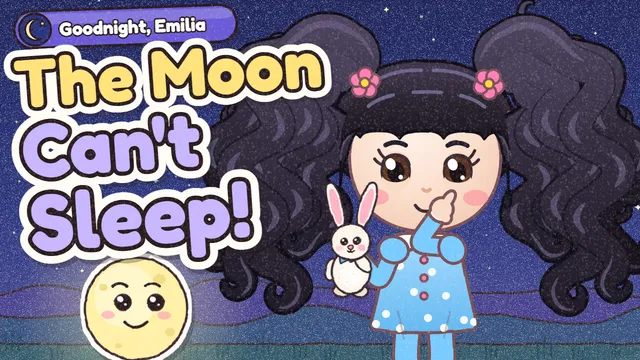
Goodnight, Emilia · Story 5
About “The Moon Who Couldn't Sleep”
- Ages: 2-5
- Length: 5 min
- Season: Goodnight, Emilia, story 5
At bedtime, Emilia looks out her window, and the moon is wide awake: he can't sleep a wink! Can you guess why? On the way to the answer, she learns that the moon changes shape (full moon, half moon, crescent), that moonlight is really sunlight, and that when it's night here, it's daytime on the other side of the world.
A wide-awake full moon gives this story its question, and three wrong guesses walk children through real science. Is he too bright to sleep? The moon makes no light of his own: moonlight is sunlight bouncing off him. Does he miss the sun? It never went to bed; it is shining on the far side of the world, where it's daytime. Is he lonely? Emilia waves and blows him a kiss. He shows his other shapes too, a half moon and a crescent like a smile, and three times he shuts his eyes at a whispered goodnight, then peeks. The answer: night is his time to shine.
- the moon
- moon phases
- day and night
- nightlights
This story is coming to YouTube soon. You can read it below and print its coloring page now.
What Emilia learns
- full moon
- half moon
- crescent
- moonlight
- sunlight
- daytime
Tips for grown-ups
- Play the peek game at lights out: whisper "Goodnight, moon," and your child shuts both eyes with one peek allowed, then none the next time. Closing eyes becomes a game instead of a demand.
- For a few nights in a row, look out the window when the moon is up at bedtime and name its shape. NASA explains that it takes about 29.5 days to go from one new moon to the next, so the shape really does change a little from night to night.
- The story's ending, that night is the moon's turn and day is the sun's, is an easy way to talk about a steady schedule. The CDC lists going to bed and getting up at the same time every day among its tips for good sleep.
- Copy the payoff: point at your child's nightlight, then at the moon, and call them the little nightlight and the biggest nightlight of all. Give each one its own goodnight.
- After the story, keep the room as calm as the moonlit rooftops. The CDC suggests a bedroom that is quiet, relaxing and cool.
Talk about it
After watching, ask:
- Why couldn't the moon sleep?
- Where does moonlight come from?
- When it's night here, where is the sun shining?
- What did Emilia blow to the moon?
- Can you show me a crescent with your hands?
- What did the moon do at the very end?
Try this together
In a dim room, shine a flashlight on a ball: the flashlight is the sun and the ball is the moon, so the bright side shows how moonlight is really sunlight. Turn the ball slowly to make a full, half and crescent moon, then switch off the sun and say goodnight.
Free coloring page
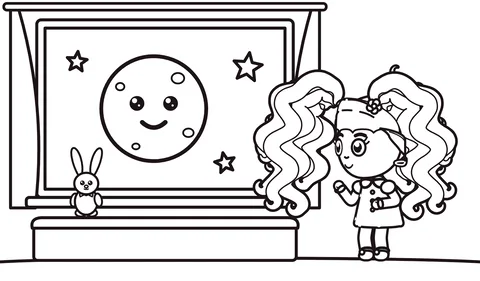
The Moon Who Couldn't Sleep: print it (US Letter or A4) or color it on screen.
Read the story
The Moon Who Couldn't Sleep. At bedtime one night,
Emilia and Pip looked out at the moon's silver light.
And the moon? He was wide awake, way up in the sky.
He couldn't sleep a wink! Can you guess why?
The moon was as round as a big white balloon.
When the moon looks all round, it's called a full moon.
He hugged a soft cloud, and he tried not to peek.
Goodnight, moon. He shut his eyes... Peek!
But the moon isn't always this round and this bright.
Some nights, he's a half moon: half dark and half light.
Little by little, he changes as the nights go by,
till he's just a thin crescent, a smile in the sky.
Was he too bright to sleep? Just look at him glow!
But the moon has no light of his own. Did you know?
The sun shines on him, and the light bounces to you.
So moonlight is really sunlight. It's true!
Did he miss the sun? Had it gone off to bed?
No, it shone on the far side of the world instead.
It was daytime there! Lambs played hide-and-seek.
Goodnight, moon. He shut his eyes... Peek!
Was he lonely up there, with nobody near?
Emilia waved, and she wiggled Pip's floppy ear.
Then she blew him a kiss... and it landed on his cheek.
Goodnight, moon. He shut his eyes... Peek!
Emilia pointed at her crescent nightlight, so small,
then up at the moon, the biggest nightlight of all!
So that's why! At night, it's the moon's time to shine.
He glows over every rooftop... yours and mine.
In the daytime, the sun shines, and we run out to play,
and at night, the moon bounces the sunlight our way.
Full moon, half moon, crescent... he shines way up high.
Tonight, he'll stay up till the sun climbs the sky.
The moonlight fell softly on the roofs and the hill,
on a dog on a porch, curled up cozy and still.
A mother bird cuddled her chicks, fast asleep.
Goodnight, doggy. Goodnight, birdies. Not a peep.
Emilia yawned. It was her turn for bed.
She climbed in with Pip and laid down her head.
The moon smiled in her window, and what do you think?
Goodnight, moon. And the moon gave a wink.
Up on her ceiling, star number five began to glow.
Next time: the forest, where night friends say hello.
Shh... the moon keeps watch. Let's sing a lullaby.
The lullaby: “Goodnight, Little Moon”
The story ends with its own lullaby, sung softly while everyone falls asleep. Sing it at bedtime, slowly.
Goodnight, little moon, a full moon so high,
a half moon, a crescent, a smile drifting by.
Your moonlight is sunlight, so soft in the night,
while far, far away, it is daytime and bright.
A wave and a kiss and a bunny held near:
you're never alone, and your friends are right here.
Goodnight, little moon, now it's your time to glow,
the nightlight for everyone sleeping below.
Goodnight, little moon... goodnight, little moon...
Questions parents ask
Is it true the moon has no light of its own?
Yes. NASA explains that moonlight is sunlight reflecting off the moon's surface. Its changing shapes come from how much of the sunlit side we can see from Earth.
Will we see a full moon tonight?
Maybe not. A full moon comes about once a month; in between, the moon shows half and crescent shapes, and for a few nights around the new moon you can't see it at all. Checking the window together is part of the fun.
Isn't the sun asleep at night?
No, and that is one of the gentle lessons here. When it is night where you are, the sun is shining on the other side of the world, where it is daytime.
Sources
Our tips follow these pages. They are general information, not medical advice: ask your child's doctor or dentist about your child.
- What Are the Moon's Phases?, NASA Space Place
- About Sleep, Centers for Disease Control and Prevention (CDC)