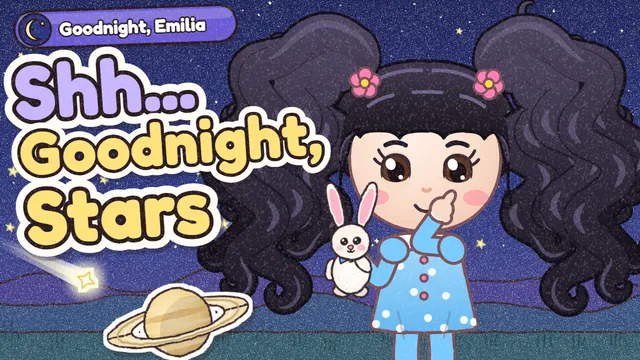
Goodnight, Emilia · Story 9
About “Goodnight, Stars”
- Ages: 2-5
- Length: 5 min
- Season: Goodnight, Emilia, story 9
From her bedroom window, Emilia and Pip say goodnight to the night sky: why stars twinkle, why the sun (a star too!) looks so big, red Mars, Saturn and its rings, star pictures called constellations, and a wish on a shooting star. And somewhere up there, a picture is hiding in the stars... can you find it?
A picture is hiding in tonight's sky, and the story is a quiet hunt for it. From her bedroom window, with Pip and a telescope, Emilia learns that stars twinkle because their light wiggles through our air, that the sun is a star too, just much closer, and that one steady red dot is Mars, a planet. Saturn shows its rings of ice and rock. Then the narrator explains that people long ago joined stars into pictures and starts a game of I spy. Seven stars, counted one by one, become the Big Dipper, a big spoon sharp-eyed children may spot early. A shooting star brings a wish.
- stars
- planets
- the night sky
- looking closely
This story is coming to YouTube soon. You can read it below and print its coloring page now.
What Emilia learns
- twinkle
- sun
- planet
- mars
- saturn
- constellation
- big dipper
- shooting star
Tips for grown-ups
- The seven Big Dipper stars glow a touch brighter from the very first picture. Don't point them out; let your child find the hidden spoon, and enjoy being right.
- The AAP encourages watching together, noting that children learn more about media when they share the experience with an adult. Sit together for the I spy page, pause, and let your child point before the lines join the dots.
- Before bed on a clear night, take a short look out the window. Depending on where you live, the season and the city lights, the Big Dipper may not be up, but there is usually one bright star to say goodnight to.
- Make the wish a quiet one. When the shooting star zooms past and Emilia shuts her eyes, shut yours too and wish without words; eyes closed and quiet is a good place to be at bedtime.
- Count the seven stars slowly on your fingers, then give each finger a goodnight, the way the bed page says goodnight to the constellations and the big star spoon.
Talk about it
After watching, ask:
- Why do stars twinkle?
- Which star is closest to us?
- What color is Mars?
- Which planet has rings?
- What picture was hiding in the stars?
- What did Emilia do when she saw a shooting star?
Try this together
Make a Big Dipper dot-to-dot: draw seven dots in a spoon shape, four for the bowl and three for the handle. Let your child count them and join them with a crayon, then tape it near the bed and say goodnight to the big spoon at lights out.
Free coloring page
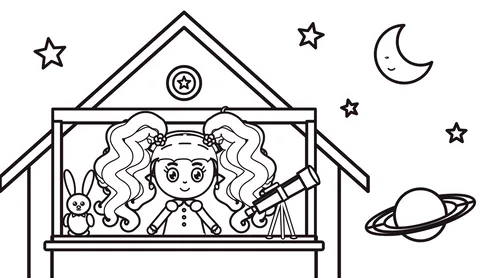
Goodnight, Stars: Emilia, Saturn and the Moon: print it (US Letter or A4) or color it on screen.
Read the story
Goodnight, Stars. The sky is so sparkly and deep,
and Emilia and Pip take a peek before sleep.
A picture made of stars is hiding up there tonight.
Can you find it? Let's look... and whisper goodnight.
Little stars filled the sky, so many, so bright,
and each one would twinkle, a blink of soft light.
Stars twinkle when starlight wiggles through our air.
Goodnight, little stars. Goodnight, stars everywhere.
Guess what? The sun is a star, just like these!
It's our very own star, warming flowers and trees.
It looks big because it's close. The rest are far away.
Goodnight, sun. Goodnight, sunshine. Sleep till day.
But one red dot didn't blink like the little stars.
It was a planet, a round world like Earth, called Mars!
Planets hardly twinkle. Mars is covered in red dust.
Goodnight, Mars. Goodnight, planet, as red as rust.
Next, Emilia peeked through her telescope, like this...
Another planet! Saturn, with rings you can't miss.
Its rings are bits of ice and rock, circling round.
Goodnight, Saturn. Goodnight, rings. Safe and sound.
Long ago, people looked up at the stars, just like you,
and connected the dots into pictures. You can too!
Star pictures are constellations. Let's play I spy!
I spy, with my little eye... a hidden picture, up high.
Emilia pointed: seven stars. Let's count. Here we go:
One, two, three, four, five, six, seven.
Now connect the dots, and look: a big spoon, all aglow!
The Big Dipper! You found it, hiding in plain sight.
Goodnight, Big Dipper. Goodnight, spoon. Sleep tight.
Then, whoosh! A little light went streaking past.
A shooting star! It's really space dust, zooming fast.
Make a wish... Emilia made one, quiet as a mouse.
Goodnight, shooting star. Goodnight, sleepy house.
With a yawn and a stretch, she climbed into bed,
hugged Pip close, and laid down her sleepy head.
Goodnight, constellations. Goodnight, big star spoon.
Goodnight, little stars. We'll look for you again soon.
Up on her ceiling, star number nine began to glow.
Her star picture is almost done. Next time: the snow.
Shh... the stars will keep watch. Let's sing a lullaby.
The lullaby: “Goodnight, Stars”
The story ends with its own lullaby, sung softly while everyone falls asleep. Sing it at bedtime, slowly.
Goodnight, little stars, as you twinkle and glow,
the sun is a star, sleeping starry in bed.
There's Mars, little planet, all dusty and red,
and Saturn, with rings going round, cozy in bed.
You found the Big Dipper, a spoon in the sky,
and you wished on a shooting star, zooming by.
Goodnight, little stars, keeping watch with your light,
now sleep, little one, all the way through the night.
Goodnight, little stars... goodnight, little stars...
Questions parents ask
Is the sun really a star?
Yes. NASA calls the sun our closest star, and an average-sized one. It looks huge and bright because it is far closer to us than any other star, and some stars are much bigger.
Is the Big Dipper a constellation?
Strictly speaking, it's a star pattern inside a larger constellation, the Great Bear, which is why the story calls it a hidden picture. NASA's kids' site describes constellations as groups of stars that make a shape and have been given a name.
What is a shooting star?
Not a star at all. It is a speck of space dust or rock that glows as it zooms into our air, just as the story says.
Sources
Our tips follow these pages. They are general information, not medical advice: ask your child's doctor or dentist about your child.
- What Are Constellations?, NASA Space Place
- All About the Sun, NASA Space Place
- Watch Together: Co-Viewing Media With Your Child, American Academy of Pediatrics (HealthyChildren.org)